
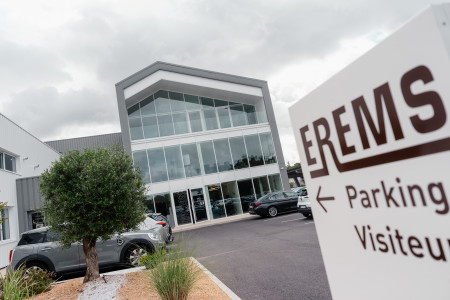

An investment of over €10 million for the expansion and modernization of its facility, bringing its total floor space to nearly 4,000 m², including 450 m² of cleanrooms. Inaugurated on June 5, 2026, and financially supported by public and private partners, these new industrial facilities aim to strengthen EREMS’s capabilities, integrate new production technologies, and meet the growing needs of major space programs such as New Space constellations.
Founded in 1979, EREMS has enjoyed continuous growth for over twenty years, driven by its contributions to major Earth observation, exploration, and telecommunications programs. The company designs and delivers systems covering a wide range of applications, from the specification phase through to turnkey delivery. This momentum has resulted in an increase in headcount, from 70 employees in 2016 to nearly 190 today, as well as a ramp-up on large-scale projects such as Pléiades Neo and the CO3D constellation. In response to this growth, EREMS has launched a major project to expand and modernize its facility, bringing its total floor space to nearly 4,000 square meters, 450 of which are dedicated to cleanroom operations.
EREMS has reached a new milestone in its industrial development. Located in a cleanroom, this production line enables the assembly of state-of-the-art components in accordance with the most stringent aerospace standards, while meeting the mass production requirements associated with satellite constellations.
With this strategic investment, EREMS now has the industrial and technological capabilities needed to keep pace with developments in the space sector. By strengthening both its production capabilities and its market position in a rapidly changing landscape, the company intends to continue its growth by simultaneously serving both government programs and the new trends driven by the New Space movement.
The site has also been redesigned to streamline workflows and improve the work environment, featuring new interconnected cleanrooms, testing laboratories, collaborative spaces, and a building dedicated to employees. Photovoltaic canopies also enable the site to generate some of its own energy for on-site consumption.